

In today’s digital era, traditional methods of trade are no longer enough to keep up with rapid market changes. Technology has made reaching customers faster and easier, and business opportunities broader than ever. The world is now connected through an integrated digital ecosystem that includes commerce, work, entertainment, and communication.
E-commerce is the core pillar of this ecosystem. It is no longer just buying and selling online, but part of a complete economic system. Studies have indicated that e-commerce accounted for 20% of global retail sales, reflecting a clear shift in consumer behavior toward digital purchasing more than ever before.
In this article, we will explore the concept of e-commerce, its types, advantages, disadvantages, and how to start with practical steps.
The Concept of E-Commerce
E-commerce is the process of buying and selling services and goods online using digital devices such as smartphones, smartwatches, and computers. This process takes place through apps and digital platforms, and it includes data collection and analysis, order management, digital marketing, and electronic payments.
A Comprehensive Comparison: E-Commerce vs Traditional Commerce
There are many differences between e-commerce and traditional commerce. Below is a comprehensive comparison:
Comparison Area | E-Commerce | Traditional Commerce |
|---|---|---|
Market Access | No physical location needed. Conducted online and not limited by geography. | Limited by geography and reaches customers in the same area only. |
Working Hours | Operates 24/7, which increases potential customers. | Limited to official business hours only. |
Physical Costs | Relatively lower. No need for space or high operating costs. | Higher costs including rent, staff, and required equipment. |
Customer Interaction | Relies on data, digital analysis, and communication via chat, email, and social media. | Relies on direct interaction, which strengthens customer trust in the product. |
The Customer Journey in E-Commerce and the Elements of the Sales Process
To understand how any online store succeeds, you need to know how a customer moves from search to purchase, and what the core elements of the sales process are.
The Purchase Journey: Search, Payment, Delivery
A customer journey always starts with a need for something that solves a problem or provides value. The customer begins browsing websites and pages searching for what they need. This is the search stage. Once they decide, they move to payment, either online or cash on delivery. After that comes order processing and shipping to the customer’s address.
Elements of the Sales Process
The sales process includes several elements:
Interface: The user interface through which customers browse products and navigate pages.
Payment: Electronic payment systems such as credit cards and other methods, and the customer may choose cash on delivery.
Shipping: Delivering products to the customer’s address on time.
Customer Service: Support before and after purchase, answering questions and inquiries.
Types of E-Commerce With Practical Examples
It is very important to understand e-commerce types and classify your activity under one of these models to save time and cost.
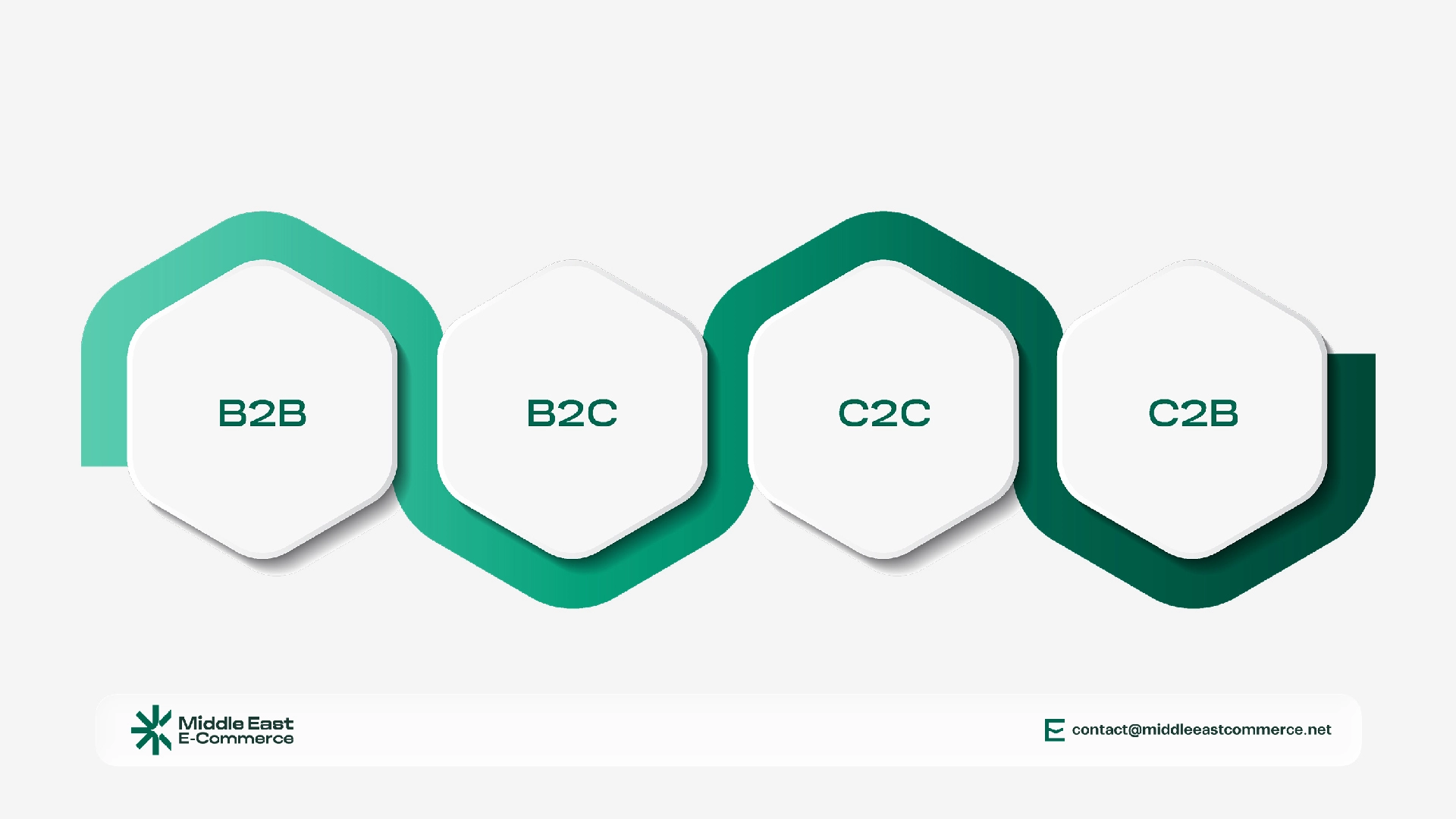
Model | Definition | Practical Examples |
|---|---|---|
Business to Business (B2B) | Selling goods and services directly between businesses. | A company like Microsoft. |
Business to Consumer (B2C) | Companies sell products or services to individuals. | Amazon, Talabat. |
Business to Government (B2G) | Companies work with governments to provide products or services. | Microsoft working with a Ministry of Health to provide cloud systems. |
Consumer to Consumer (C2C) | Consumers sell goods or services directly to other consumers through platforms. | OLX, classified ads platform for selling goods and products. |
Consumer to Business (C2B) | A consumer offers services or products and the company buys them. | Upwork, a global platform connecting businesses with freelancers online. |
In general, whatever your business type is, you no longer need to move between different platforms. At Middle East, we bring all e-commerce models together in one place, smoothly and easily.
E-Commerce Benefits for Buyers and Sellers
E-commerce, sometimes called digital commerce, opens a wide new gateway that benefits both buyers and sellers. Below are the key advantages:
Category | Benefits | Details |
|---|---|---|
Buyer | Easy access and purchasing. | Shop from anywhere at any time without going to a physical store, saving time and effort. |
Buyer | Variety and comparison. | Access a wide range of products and services and compare prices and specifications quickly before buying. |
Buyer | Competitive offers and pricing. | Lower operating costs in digital stores can lead to better offers and prices than traditional markets. |
Seller | Global customer reach. | An online store can reach a worldwide audience without geographic or time limitations, increasing sales opportunities. |
Seller | Lower operating costs. | No need for a physical location, rent, or high operating expenses, reducing overall business costs. |
Seller | Data analytics capability. | Provides accurate data on customer behavior and preferences, improving marketing strategies and increasing sales. |
Start your e-commerce journey today and benefit from faster customer reach, better offers, and precise customer data insights.
E-Commerce Drawbacks and Challenges
Unfortunately, e-commerce comes with drawbacks and challenges for both store owners and customers. Key challenges include:
No chance to physically inspect the product, relying only on photos.
Some stores set strict return conditions that may harm the customer.
Shipping schedule issues.
The shipment may be damaged.
After-sales service may be unsatisfactory.
Security risks related to customer data theft.
High digital marketing costs due to intense competition.
Risk of suppliers turning into competitors.
Difficulty building trust and credibility without a direct relationship between buyer and seller.
On Middle East, you can reduce these challenges more easily through returns management, shipment tracking, customer data protection, effective marketing tools, and trust-building features. Join now in the Free Zones and Trade section.
E-Commerce Basics for Beginners
E-commerce is not difficult, but it is not for everyone either. To make things easier, here are concise basics:
1- Choose the Product: What Will You Sell?
Choose your product first. In most cases, the best products solve a real problem. Decide whether you will manufacture it, buy in bulk, and how you will source it.
2- Study Your Target Audience: Who Will You Sell To?
Study your audience: age, interests, and where they spend time online. Identify a competitive advantage such as better pricing, higher quality, or faster shipping.
3- Pricing, Margins, and Operating Costs
Calculate pricing before you start: product cost, shipping, platform fees, and profit margin. A common rule is to keep margin at least 20% to 30% to cover potential losses.
4- Shipping, Payment, and Return Policy
Choose what fits your business:
Shipping options: standard shipping, express shipping, international shipping.
Payment options: credit cards, e-wallets, cash on delivery, bank transfer.
Return policy: define condition requirements, time window, return process, and refund method.

How to Start E-Commerce?
After understanding the basics, prepare a simple plan with clear steps:
1- Choose Your Selling Model: Where Will You Sell?
You have three options:
Ready-made platforms like Shopify with a monthly subscription.
Selling through major marketplaces such as Amazon and Noon.
Social media platforms such as Facebook and Instagram.
2- Prepare Content and Reach Customers
Test different interactive content types: images, voice-over, product descriptions, and pages, with a strong focus on video. Studies have shown conversion rates can increase by 80% when showcasing the product through video.
3- Launch Your First Marketing Campaign and Measure Results
Before creating a campaign, understand your audience and targeting. Create content that matches the audience and campaign goals, then measure results through reach rate, number of orders, cost, and ROI calculation.
Common Beginner Mistakes and How to Avoid Them?
Most common mistakes happen at the start due to limited experience and a focus on fast profit. Here are key mistakes:
1- Relying on Discounts Without Profit Margins
Lowering price does not automatically build trust and can lead to losses if margins are miscalculated to cover purchase cost, shipping, and packaging. Studies have shown that a 20% discount can reduce sales volume by 40% to 60%.
2- Ignoring User Experience and Return Policy
Statistics show 88% of users may not return to a website after a poor user experience. Make navigation simple and smooth, encourage longer time on page, and clearly explain return and exchange policies before purchase.
3- Marketing Without Tracking and Measurement
Successful marketing requires effort in data analysis, customer behavior analysis, and selecting the best channels. Selling without a strong marketing plan will not achieve the success you want.
Middle East Platform: Build Your Online Store and Connect With Customers Worldwide
At Middle East, we provide a complete digital infrastructure that enables businesses and individuals to enter e-commerce in a practical, effective way. We offer the tools and options you need as an online store owner.
Manage Products and Orders From One Dashboard
Managing products and orders from one control panel is a key advantage at Middle East. It allows you to control all operations from one place without complexity.
Product Management Details
Through the dashboard, you can:
Add products easily.
Add and edit prices and images.
Manage quantities and inventory.
Manage offers and discounts.
Organize products into categories.
See new orders immediately.
Track the status of each order.
Manage customer data.
Track payments.
Handle returns and exchanges.
Connect Sellers With International Buyers in One Unified Experience
Middle East provides a unified digital experience connecting sellers and buyers from anywhere in the world without complications.
How We Connect Sellers to Buyers
Sellers from different countries.
Buyers from different countries.
All selling and shopping tools in one system.
Products displayed globally within the same system.
Direct communication system between international customers and buyers within the same platform.
International order management system.
AI support to reach customers.
Operational Tools That Support Cross-Border Expansion
At Middle East, we help you expand beyond local markets and move into international selling within one system.
Cross-Border Tools Provided by the Platform
Global market management.
International payment solutions.
Shipping and logistics management.
Global data analytics.
Targeting the right markets with AI assistance.
Create your online store now and reach your customers worldwide with ease.
FAQs About E-Commerce Basics
1- What does e-commerce mean?
E-commerce is the process of buying and selling services and goods online using digital devices such as smartphones, smartwatches, and computers.
2- How can beginners start e-commerce?
Beginners can start by choosing where to sell, preparing content, launching marketing campaigns, and measuring results.
3- What are real-world examples of e-commerce?
A top example is Amazon, which allows millions of customers to shop and buy online.
4- What are the most important advantages and disadvantages of e-commerce?
Key advantages include:
Easy access to customers worldwide.
Product availability 24/7.
Lower operating costs compared to traditional commerce, which we provide at Middle East.
Key disadvantages include:
Difficulty building a long-term trust-based relationship between seller and buyer.
Credibility risks.
Constant reliance on the internet and the virtual environment.
Conversation
Comments
Be the first to comment.
Leave a comment