
of online demand, choosing the right platform has become one of the biggest challenges for merchants and investors.
According to the latest data, Amazon Middle East holds around 35% of the market, while Noon sellers surpassed $1 billion in sales in 2025. These figures reflect both the huge opportunities and the intense competition shaping the region’s digital commerce landscape.
However, the biggest challenge lies in relying on a single marketplace. Merchants may miss a large portion of potential customers if they do not adopt multi-channel selling strategies across the Gulf.
In this article, you will learn everything you need to choose the best platform, including a comprehensive comparison of the top online marketplaces in the Middle East 2026, fees and commissions, multi-channel selling strategies, and best practices for marketplace growth.
Get Early Access — Sell Across Multiple Channels and Manage Everything from One Place
The Top Online Marketplaces in the Middle East 2026: Market Map
With the rapid growth of e-commerce in the Middle East, it has become essential for every seller or investor to understand the top online marketplaces in the Middle East 2026, their market position, and their impact on sales.
These platforms vary in terms of market share, monthly traffic, covered countries, top-performing categories, and commission rates. By understanding this landscape, sellers can make informed decisions about which platforms are worth investing in and how to distribute their products for maximum returns.
Platform | Market Share | Monthly Visitors | Available Countries | Strongest Categories | Commission |
|---|---|---|---|---|---|
Amazon Middle East | 35% | 42 million | UAE, Saudi Arabia, Egypt, Kuwait, Oman | Electronics, books, home appliances | 5–15% depending on category |
Noon Sellers | 18% | 28 million | UAE, Saudi Arabia, Egypt | Electronics, fashion, beauty | 7–15% depending on category |
Souq | 10% | 15 million | UAE, Saudi Arabia, Egypt | Electronics, home appliances | 5–12% |
Jollychic | 6% | 12 million | UAE, Saudi Arabia, Qatar, Kuwait | Fashion and apparel | 10–20% |
Namshi | 4% | 8 million | UAE, Saudi Arabia, Kuwait | Fashion and footwear | 12–18% |
AliExpress MENA | 3% | 7 million | All regional countries | Electronics, accessories | 8–15% |
This overview of the top online marketplaces in the Middle East 2026 helps sellers understand where demand is concentrated and how to strategically position their products across different platforms.
Amazon.ae and Amazon.sa — The 35%+ Market Share Leader
Amazon Middle East leads the top online marketplaces in the Middle East 2026 with a market share of around 35%, making it the largest and most trusted platform for both buyers and sellers.
Its key strengths include global trust, fast delivery, and a massive customer base, ensuring wide product exposure and strong sales potential.
However, despite these advantages, regional sellers face challenges such as intense competition, varying fees and commissions, and strict verification processes. This makes strategic planning essential to achieve profitability on Amazon within the Middle East marketplace landscape.
Noon — The Regional Champion That Crossed $1 Billion
Noon Sellers is one of the fastest-growing platforms among the top online marketplaces in the Middle East 2026, surpassing $1 billion in sales in 2025.
It stands out due to its strong regional identity and direct support for local sellers, making it highly attractive for businesses targeting Gulf and Middle Eastern markets.
However, challenges still exist in terms of visibility, competition, and profit margins. These can be affected by platform fees and internal policies, requiring careful evaluation before starting to sell on Noon.
Other Marketplaces Worth Considering
Souq.com is one of the older players in the regional e-commerce space, offering a wide variety of products and serving sellers who want to reach diverse customer segments across the Middle East.
Jollychic focuses mainly on fashion and beauty, offering an easy-to-use interface for new sellers and a highly targeted audience, especially in Gulf countries.
Namshi is also a key platform among the top online marketplaces in the Middle East 2026, with around 4% market share and approximately 8 million monthly visitors. It operates in the UAE, Saudi Arabia, and Kuwait, focusing on fashion and footwear, making it ideal for sellers targeting a niche fashion audience.
AliExpress MENA accounts for about 3% of the regional marketplace landscape, with 7 million monthly visitors. It covers all countries in the region and is particularly strong in electronics and accessories, enabling sellers to reach a broad and diverse customer base.
Niche Platforms: When Should You Choose a Niche Marketplace?
Niche marketplaces are ideal for sellers who want to focus on a specific product category, such as luxury goods, baby products, fashion, beauty, or advanced electronics.
Choosing the right niche platform depends on your audience size, product type, and expansion goals. If your product serves a highly specific customer segment, a niche marketplace may deliver better visibility, stronger conversion rates, and less direct competition than broader platforms.

Commission & Fees Comparison: How Much Do You Actually Earn Per Platform?
When analyzing the top online marketplaces in the Middle East 2026 from a seller’s perspective, fees and commissions play a crucial role in determining net profitability.
These charges vary depending on product category, shipping method, and the platform itself. Below is a general overview of common fee structures across major platforms.
Amazon Middle East
Amazon typically charges a referral fee ranging from 5% to 15%, depending on the product category. Some categories may fall outside this range.
Fulfillment fees, including services such as FBA or Easy Ship, are additional and depend on product size and weight. These fees usually include a fixed per-unit charge plus variable shipping costs.
Additional costs may include storage fees, paid advertising, and subscription charges. In many cases, after deducting all fees and logistics costs, sellers retain a lower net margin, making full cost calculation essential before starting on Amazon.
Noon Sellers
Noon is another major player in the top online marketplaces in the Middle East 2026, with commission rates generally ranging from 5% to 15%, depending on the category.
Fulfillment services such as Noon Express add additional logistics fees based on weight and distance.
However, due to slightly lower competition in certain categories, sellers may achieve better profit margins compared to other platforms, even with similar commission rates.
Other Regional Platforms
Souq
Souq follows a similar commission structure to Amazon Middle East, with category-based fees and both self-fulfillment and platform-supported shipping models affecting final costs.
Jollychic
Although exact official commission data is limited, fees are estimated to range between 10% and 20%, with additional logistics and fulfillment charges, as is common across regional marketplaces.
Namshi
Namshi’s commission is estimated at 12% to 18%, often slightly higher due to added services such as fast delivery and returns, especially within fashion-focused platforms.
AliExpress MENA
AliExpress MENA charges are estimated between 8% and 15%, aligning with regional marketplace averages, but varying significantly based on product category and promotional policies.
Important note: These figures are approximate and may change over time. Sellers should always verify updated fees directly from official platform sources before making final business decisions.
Marketplace Fees and Commissions: What Do You Actually Earn?
When selling on the top online marketplaces in the Middle East 2026, it is not just about paying a commission per sale. Several cost components directly impact your final profitability.
Referral Fees
Referral fees vary by platform and product category, typically ranging from 5% to 20%.
Electronics and home appliances often have lower fees, while fashion and beauty categories tend to be higher due to additional logistics, returns handling, and support services.
Subscription and Account Fees
Some platforms charge monthly or annual seller fees, while others offer free registration but apply higher transaction-based charges.
This difference can significantly affect your overall cost structure, especially if you sell low-margin or high-volume products.
Shipping and Fulfillment Costs
If you use platform logistics or fulfillment services, additional fees apply based on weight, size, and delivery distance.
These costs can quickly increase total expenses, especially for bulky, heavy, or low-margin products.
Real Profit Margin: Calculate Before You Choose
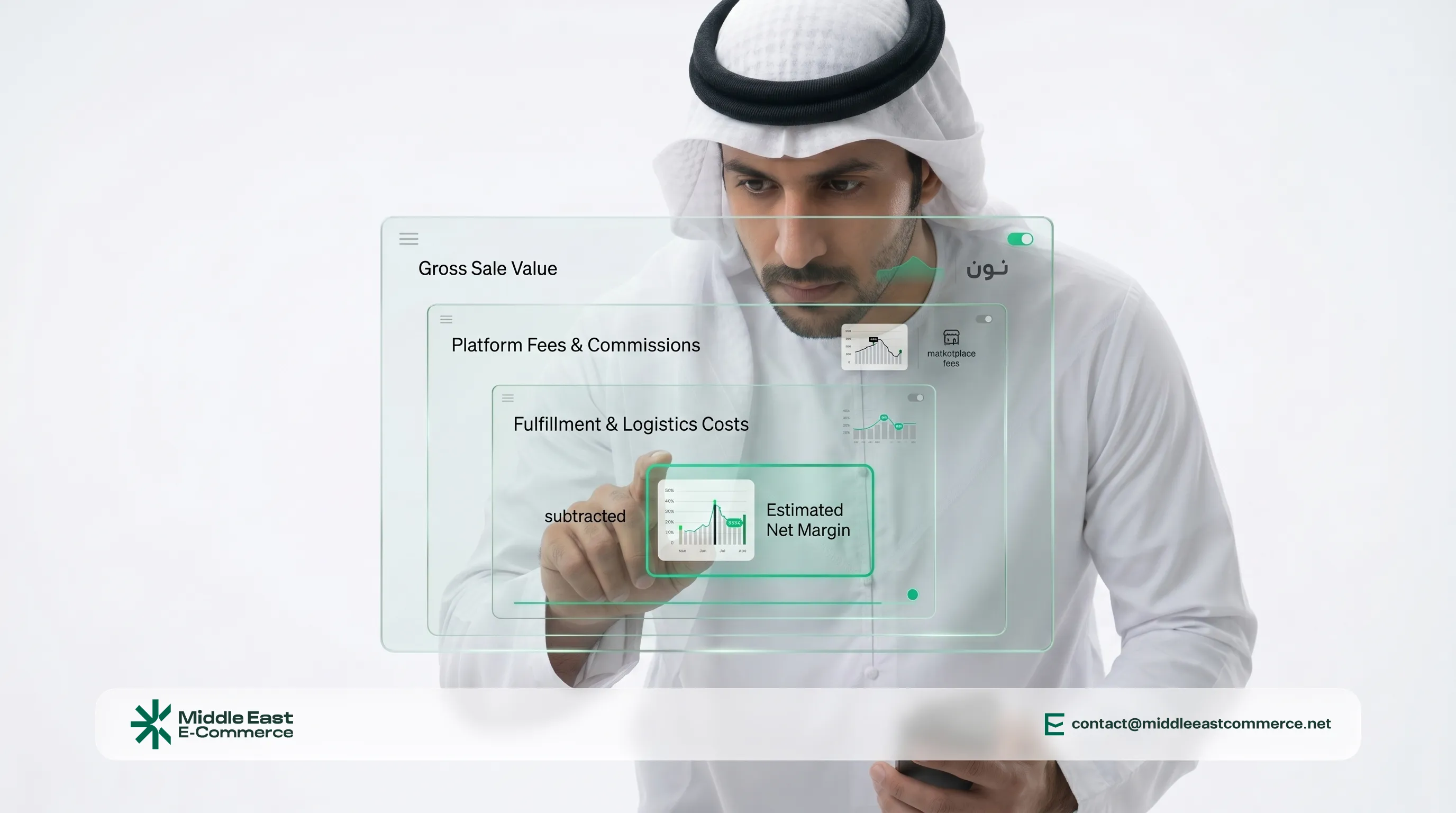
To achieve strong profitability across the top online marketplaces in the Middle East 2026, you must calculate your net margin before starting sales.
Start by adding all costs: commission fees, subscription fees, shipping, fulfillment, advertising, returns handling, and any extra charges.
Then subtract this total from your selling price. The result is your true profit margin per sale, which shows how much you actually earn.
This step is essential for selecting the right platform for each product category and avoiding unexpected costs that may reduce your real profitability.
The Multi-Channel Strategy: Why Choosing Just One Marketplace Is Risky
Relying on a single platform can limit your product reach and reduce your chances of maximizing profits.
The solution is multi-channel selling: using a centralized platform like Middle East Commerce to list and manage your products across multiple marketplaces simultaneously, while maintaining full control over inventory, pricing, and promotions.
This approach helps sellers reduce dependency on one channel, reach different customer segments, and respond more effectively to changes in fees, competition, or platform performance.
Why Is Middle East Commerce a Strong Choice for Sellers?
In the world of the top online marketplaces in the Middle East 2026, Middle East Commerce is a practical solution for managing multi-channel selling efficiently because it brings everything a seller needs into one system.
Centralized Management
Sellers can manage inventory, pricing, and promotions across all platforms from a single, easy-to-use dashboard.
This reduces manual work and helps avoid errors caused by managing multiple disconnected systems.
Multi-Platform Integration
Middle East Commerce supports selling on Amazon Middle East, Noon, Souq, Jollychic, Namshi, and AliExpress MENA without the need to register and manage each platform separately.
This helps sellers expand reach while keeping operations organized.
Performance Analytics
The platform provides detailed reports on sales, net margins, and performance per platform.
These insights help sellers make data-driven decisions across multiple marketplaces.
Time and Effort Efficiency
Managing several platforms manually can be time-consuming and error-prone.
A unified system reduces the need to switch between multiple dashboards and minimizes manual data entry mistakes.
Smart Expansion
Middle East Commerce enables sellers to reach a wider audience across the Gulf and Arab region, with easy scalability for future expansion.
Manage Amazon + Noon + Your Own Store from One Dashboard — Get Early Access
6-Criteria Platform Selection Framework
When researching the top online marketplaces in the Middle East 2026, it is essential for sellers to follow a clear framework before deciding which platform to sell on.
Below are six key criteria to consider.
1. Product Category
Identify the platform that best matches your product type.
Some marketplaces like Jollychic and Namshi are strong in fashion, while AliExpress MENA focuses more on electronics and accessories.
2. Geography
Ensure the platform covers the countries you want to target, whether Saudi Arabia, UAE, Kuwait, Qatar, or the wider Gulf region.
The right geographic fit can directly affect your delivery performance, customer reach, and conversion rate.
3. Fees and Commissions
Carefully calculate commissions, subscription fees, shipping costs, fulfillment costs, and advertising expenses before listing products.
This helps you determine your expected net margin before selling on any marketplace.
4. Audience Fit
Choose a platform where your ideal customers are active.
For example, fashion-focused shoppers may be more active on platforms like Namshi, while electronics buyers may be easier to reach on Amazon, Noon, or AliExpress MENA.
5. Support and Services
Evaluate seller support, inventory management tools, fulfillment services, and customer service quality.
Strong support can reduce operational errors and improve the overall selling experience.
6. Automation and Integration
Prioritize platforms that allow integration with multi-channel management tools like Middle East Commerce.
This enables centralized distribution, inventory control, pricing updates, and analytics across multiple marketplaces.
Frequently Asked Questions About Top Marketplaces in the Middle East 2026
What are the biggest online marketplaces in the Middle East in 2026?
Amazon leads the region with approximately 35% market share, while Noon surpassed $1 billion in sales in 2025, making both dominant players among the top online marketplaces in the Middle East 2026.
Which is better for a regional seller — Amazon or Noon?
Noon offers stronger regional support and a more localized merchant ecosystem, while Amazon provides broader geographic reach and higher brand trust.
The best choice depends on your product category, target audience, pricing strategy, and operational capacity.
Can I sell on both Amazon and Noon at the same time?
Yes. Selling on multiple platforms simultaneously is highly recommended for many merchants.
Using a centralized multi-channel management system can significantly reduce operational complexity and help sellers manage inventory, pricing, and performance across multiple platforms.
What is an alternative when marketplace fees become too high?
Building an independent e-commerce store using a unified platform can provide higher profit margins and full brand control.
Marketplaces can still remain additional sales channels, while your own store becomes the central brand asset and long-term customer acquisition channel.
Conversation
Comments
Be the first to comment.
Leave a comment