

The Zid ecommerce platform statistics 2026 show a major turning point in the Gulf e-commerce market. Zid has surpassed 150,000 merchants and expanded into four new GCC countries, making the platform one of the most recognized local e-commerce solutions in the region.
This growth is significant, but it does not automatically mean Zid is the ideal choice for every merchant. To understand the numbers properly, merchants need to look beyond the headline figures and evaluate what this growth actually means for launch speed, scalability, integrations, and long-term business goals.
The latest Zid ecommerce statistics 2026 reveal that success is not defined only by merchant count. It also depends on how well the platform aligns with your business model, whether you want to launch quickly, expand across the Gulf, or build a fully integrated digital commerce ecosystem.
Therefore, Zid platform data should be treated as one part of the decision-making process, not the only factor. A strong platform is not just the one with the biggest numbers, but the one that supports your operational needs, growth plans, and future market expansion.
In this article, you will explore the most important Zid ecommerce platform statistics 2026, including merchant growth, GCC expansion, Zid vs Salla comparison, platform strengths and limitations, and the best alternatives for ambitious merchants in 2026.
Zid by the Numbers: Official Zid Ecommerce Platform Statistics 2026
The Zid ecommerce platform statistics 2026 provide a clear view of the platform’s rapid growth over a relatively short period.
By reviewing official Zid data and market reports from sources such as Zid Official and Wamda, we can understand the platform’s development in terms of merchant adoption, geographic expansion, and annual growth indicators.
Indicator | Figure | Source |
|---|---|---|
Active merchants | 150,000+ | Zid Official |
Geographic expansion | 4 GCC countries | Wamda |
Annual growth rate | Double-digit growth | Market analysis |
Merchant type | Individuals + emerging brands | Zid Official |
150,000+ Merchants: Scale, Competition, and What It Signals
The figure of 150,000 merchants refers to the total number of registered and active stores on the Zid e-commerce platform. This number is one of the strongest indicators in the Zid ecommerce platform statistics 2026, as it reflects a high level of trust among merchants in Saudi Arabia and the wider Gulf market.
This growth is supported by several key factors:
Strong expansion campaigns within Saudi Arabia.
Targeting entrepreneurs and small businesses.
Simplifying store creation in a very short time.
However, Zid merchant numbers should be interpreted carefully. A high number of merchants does not necessarily mean that all stores are active, profitable, or generating strong revenue. For this reason, merchants should use these statistics as a growth signal, not as a final decision-making factor.
4 New Gulf Markets: Where Has Zid Expanded?
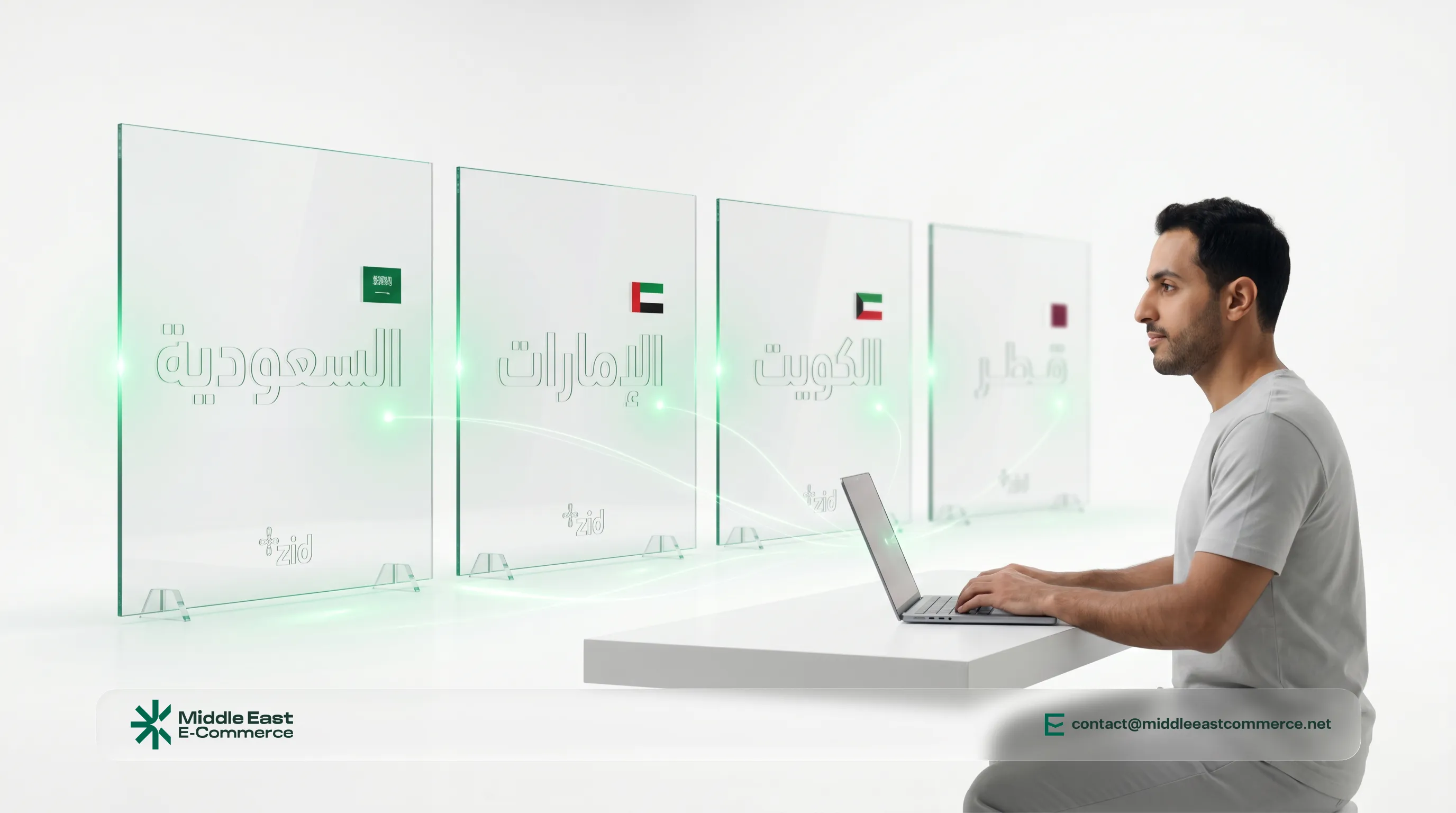
The latest Zid growth data shows that the platform has started executing its GCC expansion strategy by entering several key regional markets, including:
United Arab Emirates.
Kuwait.
Bahrain.
Qatar.
This expansion was not merely a symbolic launch. According to available Zid platform insights, it also included partial support for payments and logistics services in these markets.
However, Zid’s presence is still stronger in some countries than others. Its GCC expansion is promising, but the platform remains most deeply rooted in the Saudi market, where merchant awareness, service coverage, and platform adoption are more mature.
Zid’s Year-on-Year Growth Trajectory
The Zid ecommerce statistics 2026 are not limited to merchant count alone. They also include growth indicators that provide a clearer view of the platform’s performance over time.
Key growth indicators include:
Continuous increase in new store registrations.
Rising adoption among new merchants.
Expansion of services offered within the platform.
Growing awareness of Zid across Gulf markets.
The available data indicates that Zid’s annual growth falls within the double-digit range, reflecting a market that is still expanding. From a strategic perspective, this growth also highlights the need for stronger technical infrastructure to support merchants who move from early-stage selling to advanced scaling.
Discover now: UAE Online Shopping Statistics 2026: 78% of the Population Shops Online
Zid’s Core Strengths: Why 150,000 Merchants Trust It
The Zid ecommerce platform statistics 2026 help explain why the platform has reached more than 150,000 merchants. This growth was not accidental, but the result of practical advantages that appeal to entrepreneurs, small businesses, and emerging brands.
A deeper look at Zid platform adoption shows that merchants often choose Zid because of ease of use, local integrations, payment options, shipping connections, and a store-building experience designed for non-technical users.
Customisation Flexibility and Merchant-Friendly UX
One of Zid’s strongest advantages is the ease of building an online store with a simple and smooth user experience. The platform provides ready-made templates that allow merchants to launch quickly without requiring advanced technical skills.
This makes Zid a strong choice for beginners and small businesses that want to start selling online without hiring a development team.
However, the Zid ecommerce statistics 2026 also show an important tradeoff: customization flexibility is moderate compared to some global platforms. Zid prioritizes simplicity over deep customization, which makes it easy to use but potentially limiting for large-scale or highly complex stores.
Gulf Payment and Shipping Integrations
One of the most important insights from Zid platform data is the strength of its local integrations. Zid supports a wide range of payment gateways and shipping providers within Saudi Arabia and the wider Gulf region.
These integrations include:
Local and regional payment gateways.
Shipping companies across Saudi Arabia and the GCC.
Cash-on-delivery solutions.
Operational tools for daily order management.
This level of integration simplifies operations for merchants without requiring complex external tools. It also explains part of Zid’s popularity among sellers who want a platform that understands Gulf market requirements.
Analytics Dashboard and Store Growth Tooling
The Zid ecommerce platform statistics 2026 indicate that the platform provides analytics tools that help merchants monitor performance and make better business decisions.
These tools include:
Sales reports.
Customer behavior analysis.
Order tracking.
Store performance indicators.
These features are useful for small and medium-sized businesses. However, merchants who require advanced analytics, deeper automation, or third-party BI integrations may eventually need additional tools beyond Zid’s native dashboard.
Explore now: Paying with MEEC - Digital Currency for All E-Commerce Services
Zid’s Limitations: What the Platform Does Not Cover
The Zid ecommerce statistics 2026 show strong growth and wide adoption across the Gulf market, but a balanced analysis also requires looking at what the platform does not fully cover.
Zid is effective for launching and managing online stores, especially in Saudi Arabia and the GCC. However, merchants planning long-term growth, international expansion, or complex digital business models may need to evaluate whether Zid’s current ecosystem is enough.
Beyond the Store: Jobs, Auctions, and Integrated Communications
Zid mainly focuses on building and managing online stores. It does not yet offer a fully integrated ecosystem that includes advanced features such as:
Auction systems.
Multi-vendor marketplace models.
Built-in social or messaging communication features.
Job and workforce management tools.
Unified content and community features.
These functions often require external tools or custom development, which may increase operational complexity for some businesses.
This does not necessarily make Zid a weak platform. It simply reflects the platform’s focus on simplicity and streamlined e-commerce operations. However, it may not be sufficient for merchants aiming to build broader digital ecosystems or alternative business models.
Expanding Beyond the Gulf: Is Zid Enough for Wider Markets?
The Zid ecommerce platform statistics 2026 show clear success across GCC markets, but broader international expansion creates new requirements.
When moving toward markets such as Europe, the United States, or wider global commerce, merchants may face challenges such as:
Limited international integrations compared to global platforms.
Need for more advanced multi-currency support.
Global tax and compliance requirements.
More complex logistics and fulfillment models.
Advanced localization and language support.
This means Zid can be highly effective for GCC expansion, but merchants scaling globally may need complementary tools or a more flexible digital ecosystem.
Learn more about: GCC Ecommerce Growth Rate 2026: Who Leads and Who Follows?
Zid vs Salla: The Comparison Every Gulf Merchant Wants
The comparison between Zid and Salla is one of the most searched topics among Gulf merchants. Both platforms are strong local e-commerce solutions, and both target sellers who want to launch and manage online stores without heavy technical complexity.
The Zid ecommerce platform statistics 2026 show the level of competition between both platforms, but the decision should not be based only on numbers. It should depend on the merchant’s goals, target market, customization needs, and business stage.
Element | Zid | Salla |
|---|---|---|
Number of merchants | 150,000+ | 70,000+ |
Geographic expansion | GCC, 4 countries | Strong focus on Saudi Arabia |
Ease of use | Very easy for beginners | Easy with more advanced options |
Customization | Medium | Relatively higher |
Integrations | Strong locally | Strong and diverse |
User type | Beginner – Intermediate | Beginner – Advanced |
What Both Platforms Do Well
Both Zid and Salla offer core features that make them among the strongest e-commerce platforms in the Gulf market.
They both provide:
Quick and easy online store setup.
Support for local payment gateways.
Integration with shipping companies.
User-friendly interfaces for non-technical users.
Tools that help entrepreneurs start selling quickly.
These factors explain why both platforms have gained strong adoption among entrepreneurs and small businesses in the Gulf region.
Key Differences: When to Choose Zid vs Salla
The real difference between Zid and Salla becomes clearer when you evaluate merchant needs rather than headline statistics.
Choose Zid if you:
Target GCC expansion.
Want a fast and simple store launch.
Focus on the local market with gradual growth.
Prefer ready-made operations with payments and shipping support.
Choose Salla if you:
Need higher customization flexibility.
Plan to build a more advanced feature-rich store.
Focus primarily on the Saudi market.
Want broader control over design and store structure.
Based on current Zid platform data, the decision is not about which platform is universally better. It is about which platform is more suitable for your current business stage and future growth direction.

Who Should Choose Zid — A Clear Decision Framework
The Zid ecommerce statistics 2026 show that the platform is not equally suitable for everyone. Its effectiveness depends on your business type, technical needs, and stage of growth.
Rather than relying only on merchant count or expansion figures, use the following framework to decide whether Zid fits your business.
When Is Zid the Smart Choice for You?
Zid may be a strong fit in the following cases:
You are launching a new store and need fast execution without technical complexity.
You run a small or medium-sized business and want stable, easy management.
Your main focus is the Saudi market or expansion within the GCC.
You prefer ready-made solutions that include payments and shipping without complex integrations.
You want a platform designed around local merchant needs.
In these cases, Zid offers a strong balance between simplicity and essential functionality, making it a solid starting point for many merchants.
When Should You Look for an Alternative to Zid?
Despite Zid’s strong growth, there are situations where other solutions may be more suitable.
You may need an alternative if:
You require deep technical customization or a fully unique user experience.
You are building complex business models such as multi-vendor marketplaces.
Your goal is global expansion outside the Gulf region.
You need advanced marketing automation and deeper analytics.
You want an integrated system that combines commerce, communication, hiring, content, and auctions.
In these cases, Zid may need external tools to extend its capabilities, or it may need to be replaced by a more flexible solution depending on your long-term growth strategy.
Look now: Best Selling Products Online Gulf 2026: Fashion at 38.7% Leads the Pack
Beyond Zid: When Ambition Outgrows a Single Platform
When your business grows beyond basic e-commerce activity, you may encounter a ceiling that requires a broader digital ecosystem than a traditional store-first platform.
Zid can be highly effective during the launch and early growth stages. However, larger-scale projects that require multiple functions—such as job management, auctions, social networks, direct communication, advanced analytics, and multi-brand operations—need a more comprehensive infrastructure.
Modern digital commerce is moving toward unified solutions that combine commerce, data management, communication, content, and business operations. This reduces reliance on multiple disconnected tools and creates stronger integration across all business components.
Middle East: A Model for an Integrated Digital Platform
The Middle East platform presents a different vision compared to traditional e-commerce platforms. It is not limited to buying and selling stores only, but expands into several dimensions of digital business.
According to its ecosystem, it is a fully integrated solution combining commerce, work, content, jobs, communication, analytics, and auctions within a single system.
Multi-Store and Multi-Brand Management in One Account
As your business grows, you may need to operate multiple stores or brands under a single management system.
This feature allows you to separate products and categories for each store, create custom offers and pricing strategies for each segment, and track inventory and orders centrally.
This simplifies operations, saves time, and eliminates the need to manage multiple accounts and tools, enabling smoother expansion into new markets.
Multi-Currency and International Tax Support
When expanding into different markets, handling multiple currencies and dynamic pricing becomes essential. Businesses also need to manage international taxes and comply with regulations across different countries.
The Middle East platform provides these capabilities to support international expansion, reduce accounting complexity, and maintain a seamless shopping experience for customers across regions without relying heavily on external accounting systems.
Integrated Job Portal for Hiring and Workforce Management
The Middle East platform is not limited to commerce; it also includes an internal job portal for managing hiring processes.
Businesses can publish job opportunities, receive applications, and categorize resumes. Job listings can be linked directly to business operations, allowing employers to identify suitable candidates and improve talent management efficiency.
Multi-Vendor Marketplace and Digital Auction System
This feature enables the creation of a multi-vendor marketplace within the same platform, with full control over commissions and performance tracking for each seller.
It also supports digital auctions for products and services, increasing sales opportunities and maximizing value. This transforms the platform from a simple online store into a fully integrated commercial ecosystem that supports large-scale business growth and opens new revenue channels.
Unified Customer Communication
Customer engagement is a core factor in digital success. The platform provides advanced communication tools, including direct messaging, smart behavior-based notifications, product reviews, and targeted marketing campaigns.
These features enhance customer experience, increase loyalty, and improve conversion rates without relying on multiple external tools.
Advanced Dashboards and Analytics for Strategic Decision-Making
Middle East Commerce provides advanced dashboards that allow businesses to monitor sales, inventory, customer activity, and marketing performance in one place.
It also offers detailed analytics per product or vendor, along with AI-driven insights that support strategic decision-making, helping businesses increase profitability and improve overall performance.
Full Integration of Commerce, Jobs, Communication, and Auctions in One System
The strongest advantage of this integrated platform is the unification of all core functions: store management, hiring, customer communication, and auctions within a single system.
This reduces dependency on external tools, saves time, and simplifies operations. The result is a unified digital ecosystem that supports both daily operations and long-term strategic growth.

Frequently Asked Questions About Zid Ecommerce Platform Statistics 2026
How many merchants use the Zid platform?
Zid serves more than 150,000 merchants according to its official 2026 data.
Which Gulf countries does Zid operate in?
Zid was launched in Saudi Arabia and has expanded into four additional GCC countries. For the most updated list, merchants should refer to Zid’s official website.
Is Zid better than Salla for a Gulf merchant?
Both platforms are strong options in the Gulf e-commerce market. The better choice depends on your required features, target markets, customization needs, and long-term growth strategy rather than absolute superiority.
Is Zid sufficient for expansion beyond the Gulf?
Zid can be effective for GCC-focused expansion, especially for small and medium-sized stores. For expansion outside the GCC or for more integrated needs such as jobs, auctions, real-time communication, and multi-vendor operations, a more comprehensive platform may be required.
Conversation
Comments
Be the first to comment.
Leave a comment